The Conventional Wisdom on Retirement Income
There are countless articles on retirement income strategy that focus on how much you need to save, how much income you’ll require, and how to make your money last. However, many of these approaches are based on the assumption that your retirement spending should mirror your pre-retirement lifestyle.
The underlying premise is that you’ll need a certain percentage – often cited as 80% – of your pre-retirement income to maintain your standard of living. This figure accounts for the elimination of certain work-related expenses like payroll taxes, commuting costs, and professional attire. Then there’s the famous 4% rule, which estimates how much you can withdraw annually from your retirement fund without depleting it prematurely.
Our Retirement Income Strategy: Spend More, Sell Nothing
However, I take a different approach. My wife and I actually spend more in retirement because we want to travel extensively and indulge in pursuits like fine dining, wine tasting, and attending concerts. Simultaneously, we’re growing our retirement fund with the intent of leaving a legacy for our children and grandchildren. In the 98 months since retiring, our portfolio has appreciated by 180% as of October 2, 2026 – returns on par with low-cost S&P 500 index funds or ETFs, despite my supposed investing acumen.
A key difference in our retirement income strategy is that we don’t adhere to the 4% withdrawal rule or any similar approach. Instead, we live solely off our taxable dividend income and Social Security, without selling assets to fund our lifestyle. This negates the need for a balanced portfolio, which is typically recommended to avoid selling temporarily depressed holdings during market downturns. Market crashes don’t faze us, as long as the underlying economy remains healthy, since we’re not reliant on liquidating positions.
Why Dividends Sidestep the 4% Rule’s Problem
The 4% rule exists to solve a real problem: sequence-of-returns risk. If you fund retirement by selling shares, a crash early in retirement can permanently dent the portfolio. Dividends sidestep the problem entirely. When share prices fall, the dividends keep arriving — and we never have to sell a single share at the wrong time. The income and the portfolio value are decoupled, so a down market changes our net worth on paper but not our paycheck. That’s the quiet advantage of a dividend-first retirement income strategy: the market can do whatever it wants, because our income doesn’t come from the market’s mood — it comes from the businesses’ cash registers.
The Barbell: Dividends on One End, Growth on the Other
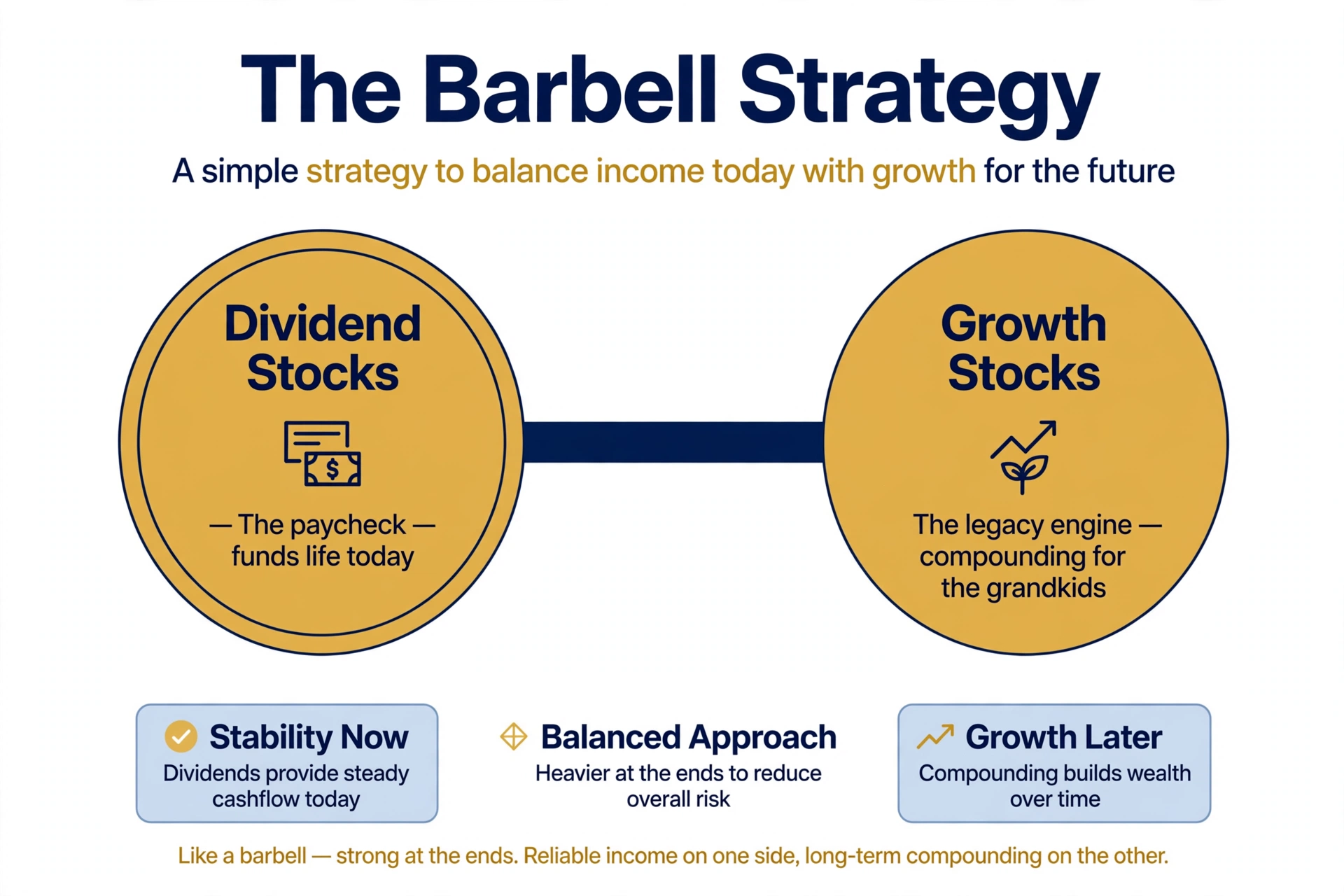
Our approach may not be the “best” way to manage a retirement portfolio, but it works for us. To capture growth without sacrificing income, we employ a “barbell” strategy, allocating portions of our portfolio to dividend stocks and growth stocks respectively.
Each end of the barbell has a job. The dividend end is the paycheck — it funds our life today. The growth end is the legacy engine — it’s what we’re compounding for our children and grandchildren. We never raid one end to feed the other, which is why the strategy survives both our spending and the market’s moods.
On the dividend end sit steady payers like Altria, Energy Transfer, and Realty Income — the paycheck. On the growth end are positions like NVIDIA and Broadcom, bought years ago at a fraction of today’s prices and left alone to compound. This is the retirement income strategy in miniature: income we spend, growth we keep.
While deviating from conventional wisdom, our retirement funding approach aligns with our lifestyle goals and priorities. By avoiding the sell-off of appreciated assets, we aim to maximize long-term growth potential while enjoying our retirement years to the fullest.
Your Comments would be appreciated.
